

By Andrew Siyabalawatte, June 2023.
You don’t need an expensive gym membership or a room full of specialist equipment to start improving your strength and mobility. Sometimes, all you need is a comfortable mat, a little space and the right guidance.
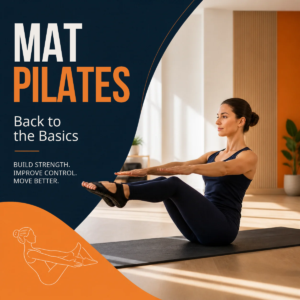
Mat Pilates is a popular form of exercise that uses controlled movements, breathing techniques and bodyweight resistance to strengthen the muscles that support your body. Whether you’re looking to improve your posture, build core strength, become more flexible or simply feel more comfortable in your everyday movements, Pilates can be a great addition to your routine.
At Back To Health Wellness in Guildford, we understand that everybody moves differently. Some people want to improve their general fitness, while others are looking for ways to manage stiffness, support their recovery or feel more confident with movement.
In this guide, we’ll explore what mat Pilates involves, its benefits, the exercises you can try at home and how it can complement your wider approach to back and musculoskeletal health.
What Is Mat Pilates?
Pilates was developed by Joseph Pilates in the early 20th century. His approach combined controlled movements, breathing and concentration to develop strength, coordination and body awareness.
Unlike some forms of exercise that focus primarily on speed or lifting heavier weights, Pilates places considerable emphasis on the quality of each movement.
Mat Pilates involves performing a series of exercises on a padded mat, generally using your own bodyweight to create resistance. The movements can be adapted to suit different abilities, making it accessible to beginners as well as people who already exercise regularly.
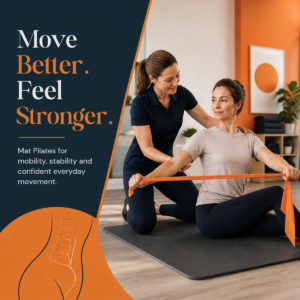
You don’t necessarily need specialist equipment. Many exercises use nothing more than your bodyweight, although small accessories such as resistance bands, Pilates balls and light weights can introduce additional challenges.
The key is to move with control rather than rushing through repetitions.
The Five Fundamentals of Mat Pilates
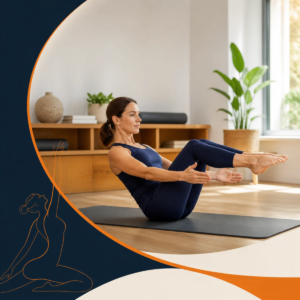
Good Pilates technique starts with understanding how your body moves. There are five important principles that help form the foundation of a Pilates practice.
1. Breathing
Breathing is an important part of Pilates. Learning to coordinate your breathing with movement can help you maintain control and avoid unnecessary tension.
Rather than holding your breath during a challenging exercise, you learn to breathe steadily while engaging the muscles needed to support the movement.
2. Neck and Head Alignment
The position of your head and neck can influence how comfortably you perform an exercise.
Maintaining a comfortable, neutral alignment helps avoid unnecessary strain, particularly during movements involving the upper body.
3. Ribcage and Shoulder Blade Control
Your shoulders and ribcage play an important role in maintaining upper-body stability.
Pilates encourages controlled shoulder movements and awareness of the muscles around the shoulder blades. This can be particularly useful for people who spend long periods sitting at a desk.
4. Pelvic Mobility
The pelvis connects your upper and lower body, so controlling its movement is an important part of Pilates.
Exercises that involve gentle pelvic tilting and controlled hip movements help develop awareness of how your lower back and pelvis work together.
5. Core Stability
Core stability is one of the best-known aspects of Pilates.
Your core includes more than just your abdominal muscles. It also involves muscles around your back, pelvis and hips that help support your body during everyday activities.
Learning to engage these muscles appropriately can help improve movement control, balance and overall stability.
What Are the Benefits of Mat Pilates?
One of the reasons mat-based Pilates has become so popular is its versatility. You can adapt exercises to your ability and gradually increase the challenge as your confidence improves.
Here are some of the main benefits.
Improving Core Strength
Your core muscles help support your body when you bend, lift, walk, sit and stand.
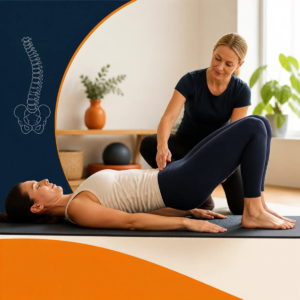
Mat Pilates includes exercises that challenge these muscles through controlled movements, helping develop strength and coordination.
A stronger, more coordinated core can support better movement control during everyday activities and other forms of exercise.
Supporting Better Posture
Spending hours sitting at a desk, driving or looking down at a phone can influence how we hold our bodies.
Pilates encourages greater awareness of spinal alignment, shoulder positioning and pelvic control.
By strengthening muscles involved in maintaining posture, regular practice may help you become more aware of how you sit, stand and move throughout the day.
Improving Flexibility and Mobility
Strength is only one part of healthy movement. Your body also needs to move comfortably through different ranges of motion.
Many Pilates exercises involve controlled movements of the hips, spine and shoulders. Over time, these movements can help improve mobility and flexibility.
Importantly, flexibility doesn’t mean forcing your body into the deepest possible stretch. The aim is to develop comfortable, controlled movement that suits your individual needs.
Developing Balance and Coordination
Pilates exercises often require you to maintain stability while moving different parts of your body.
For example, lifting one leg while keeping your pelvis steady challenges your coordination and balance.
These skills are useful beyond the exercise mat, particularly when walking, climbing stairs or participating in sports and other physical activities.
Building Body Awareness
An often-overlooked benefit of mat Pilates is learning to understand your own body.
You begin to notice how your shoulders, hips, spine and abdominal muscles work together. You may also become more aware of movements that feel comfortable and those that need modifying.
This awareness can help you make better decisions about your exercise routine and how you approach everyday physical activities.
Five Mat Pilates Exercises You Can Try
You don’t need to perform dozens of repetitions to make a Pilates session worthwhile. The focus should be on controlled movement, good technique and consistency.
Here are five exercises that demonstrate some of the basic principles of mat Pilates.
1. The Pilates Pelvic Tilt
The pelvic tilt is a gentle introductory exercise that helps develop awareness of your pelvis and lower back.
How to perform it:
- Lie on your back with your knees bent and feet resting flat on the mat.
- Allow your spine to settle into a comfortable neutral position.
- Gently tilt your pelvis so that your lower back moves towards the mat.
- Slowly release and return to your starting position.
- Repeat the movement while breathing naturally.
This exercise is a useful starting point for understanding pelvic control and coordinating your abdominal muscles.
2. The Pilates Roll-Up
The roll-up is a classic Pilates movement that challenges abdominal strength, spinal mobility and coordination.
This is a challenging exercise for beginners. A smaller range of movement or a modified version may be more appropriate initially.
3. The Spine Twist
The spine twist is a seated exercise that encourages controlled rotation through the upper body.
How to perform it:
- Sit upright with your legs comfortably positioned.
- Extend your arms out to the sides.
- Gently rotate your upper body to one side.
- Return to the centre before rotating to the opposite side.
- Keep your movement controlled and avoid forcing the rotation.
This exercise helps develop awareness of spinal rotation and upper-body control.
4. The Glute Bridge
The glute bridge is a useful exercise for strengthening the muscles around your hips and pelvis.
How to perform it:
- Lie on your back with your knees bent and feet flat on the floor.
- Gently engage your abdominal muscles.
- Lift your hips until your shoulders, hips and knees form a comfortable line.
- Pause briefly at the top.
- Slowly lower your hips back to the mat.
The exercise challenges the gluteal muscles and muscles that help stabilise your pelvis.
5. The Pilates Plank
The plank is a more challenging exercise that involves several muscle groups working together.
How to perform it:
- Begin on your hands and knees.
- Position your hands underneath your shoulders.
- Extend your legs behind you, resting on your toes.
- Keep your body in a comfortable straight line.
- Hold the position while breathing normally.
If a full plank feels too difficult, you can start with your knees on the mat.
The aim isn’t to hold the position for as long as possible. Good technique is more important than duration.
Mat Pilates vs Reformer Pilates: What’s the Difference?
Both mat Pilates and Reformer Pilates are based on similar principles, but the equipment used and the way resistance is created are different.
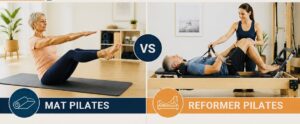
| Feature | Mat Pilates | Reformer Pilates |
| Equipment | Uses a Pilates mat and your own bodyweight. | Uses a specialised machine with springs, straps and a sliding carriage. |
| Resistance | Relies mainly on bodyweight and gravity. | Uses adjustable spring resistance to create different levels of challenge. |
| Exercises | Performed lying down, sitting, standing or on hands and knees. | Uses the reformer machine to perform a wider variety of supported and resisted movements. |
| Difficulty | Can be adapted for beginners and more experienced participants. | Can also suit different abilities, depending on the exercises and spring settings. |
| Support | Primarily relies on your own body control and stability. | The machine can provide support during certain movements. |
| Flexibility | Easy to practise at home with minimal equipment. | Requires access to a reformer machine. |
| Best suited for | People looking for an accessible way to develop core strength, balance and flexibility. | People who want to explore machine-based Pilates with adjustable resistance. |
What Equipment Do You Need for Mat Pilates?
One of the biggest advantages of mat Pilates is that you can get started without buying lots of equipment.
Here are a few useful items:
- Pilates mat: A comfortable, non-slip mat provides cushioning and support, particularly when performing exercises on your back, knees or hands.
- Resistance bands: These can introduce additional resistance and help challenge different muscle groups.
- Small Pilates ball: A soft ball can be used to introduce support or additional stability challenges during selected exercises.
- Light dumbbells: These can be incorporated into some routines to challenge the upper body.
- Comfortable clothing: Choose clothing that allows you to move freely without restricting your range of motion.
If you are exercising at home, start with the basics. You can always introduce additional equipment once you become more familiar with the movements.
Is Mat Pilates Suitable for Beginners?
Absolutely. One of the appealing aspects of mat Pilates is that many exercises can be modified to suit different experience levels.
If you are new to exercise, you don’t need to master every movement straight away. Start with simpler exercises, concentrate on your breathing and gradually build your confidence.
You may also find that some movements feel more challenging than others. This is perfectly normal.
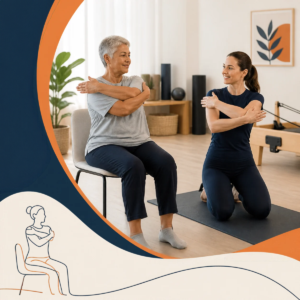
For people who struggle with getting down onto the floor or kneeling, chair-based Pilates movements can provide an alternative.
At Back To Health Wellness, our Pilates sessions in Guildford cater for people with different levels of experience. Our classes include options for those who prefer to work from a chair rather than a mat.
The important thing is finding an approach that works for your body rather than trying to keep up with everyone else.
Can Mat Pilates Help With Back Pain?
This is a common question, particularly among people who spend long hours sitting or have experienced recurring back discomfort.
Pilates can be a useful part of a wider approach to managing certain types of back pain. Exercises that develop core strength, movement control and hip mobility may help people move with greater confidence.
However, back pain has many possible causes, and not every exercise is suitable for every person.
For example, someone experiencing acute back pain may need a different starting point from someone who simply wants to improve their general fitness.
This is where understanding your individual needs becomes important.
At Back To Health Wellness, we believe that good movement starts with understanding how your body works. If you’re experiencing persistent pain or discomfort, an appropriate assessment can help establish which exercises and activities are suitable for you.
You can also learn more about our physiotherapy and massage services in Guildford, where our HCPC-registered physiotherapists provide personalised care and rehabilitation advice.
Yoga vs Mat Pilates: Which Is Better?
Yoga and Pilates are both popular ways to improve physical wellbeing, but they approach movement differently.
Yoga generally combines physical postures, breathing and, in many styles, meditation. Some practices involve holding positions for longer periods, while others flow continuously between movements.
Mat Pilates places greater emphasis on controlled repetitions, muscular strength, core stability and movement coordination.
Neither is necessarily better than the other.
Your individual needs, preferences and physical abilities should influence which approach you choose.
For example, people with hypermobility may need to be particularly mindful of how far they stretch. Greater flexibility isn’t always better, and repeatedly pushing joints towards their end range may not be appropriate.
In these situations, exercises that focus on controlled movement and strength may be more useful than simply trying to increase flexibility.
If you are unsure which approach is suitable, professional guidance can help you make an informed decision.
How Often Should You Practise Mat Pilates?
There is no single routine that works for everyone.
If you’re just starting, one or two sessions a week can be a sensible way to become familiar with the exercises and understand how your body responds.
As your confidence improves, you may decide to practise more regularly.
Consistency is generally more useful than trying to complete an intense workout every day.
Allow yourself time to recover, particularly when introducing unfamiliar exercises or increasing the difficulty of your routine.
If you experience pain, dizziness or unusual symptoms during an exercise, stop and seek appropriate advice rather than pushing through it.
Discover Pilates at Back To Health Wellness in Guildford
At Back To Health Wellness, we recognise that looking after your body involves more than simply treating discomfort when it appears.
Understanding how you move, developing strength and maintaining mobility can all play an important role in supporting your long-term wellbeing.
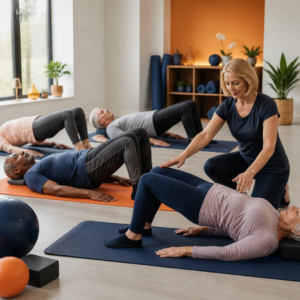
Our Pilates sessions in Guildford are designed to help people improve strength, balance, movement control and flexibility in a welcoming environment.
Whether you’re completely new to Pilates or returning after a break, there are options to suit different abilities and preferences, including individual sessions and group classes.
We also understand that some people need a little extra guidance before introducing new exercises, particularly if they have a history of back pain, stiffness or injury.
Our wider services include physiotherapy, massage and other approaches to musculoskeletal health, allowing us to consider your needs as a whole rather than focusing on just one aspect of your wellbeing.
If you’d like to find out more, visit our Pilates in Guildford and Surrey page or explore our physiotherapy and massage services.